Subject
Applies to: Admin/Branch Manager
Purpose: Understanding Distribution Rules Operators
Location in Ricochet: Configuration > Distribution & Tags
Description
The instructions in this article require Administrator permission
This article describes the different operators, their meanings and uses when creating new distribution rules.
Reference
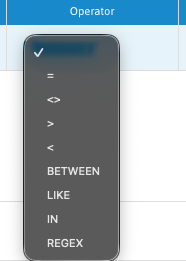
| Operator | Function | Example |
| = | Exact Match | Vendor = "ABC Vendor" |
| <> | Not Equal To | State <> "CA" |
| > | Greater Than | Home Value > 1,000,000 |
| < | Less Than | Price < 100 |
| BETWEEN | Range of values | Age BETWEEN 18 AND 65 |
| IN | Match any from list | Vendor IN "ABC Vendor, XYZ Corp" |
| LIKE | Partial Match | Email LIKE "@gmail.com" |
| REGEX | Pattern Match | Phone REGEX ^[0-9]{3}-[0-9]{3}-[0-9]{4}$ |
Screenshot of the Operator selections in Distribution & Tags:
Detailed Operator Definitions
When creating distribution rules in Ricochet360, you must select an operator to define how the system filters your leads.
Below is a definition of each available operator.
Basic Operators
- = (Equals)
The value entered on the lead must be exactly as is on the rule.- Use this for exact matches (e.g., Vendor = "ABC Vendor").
- <> (Not Equal)
The value on the lead must not equal the value entered on the rule.- Use this to exclude specific values (e.g., State <> "CA").
- > (Greater Than)
The value on the lead must be greater than the value entered on the rule.- Typically used for numerical values or dates (e.g., Home Value > 1,000,000).
- < (Less Than)
The value on the lead must be less than the value entered on the rule.- Typically used for numerical values or dates (e.g., Price < 100).
Advanced Operators
- BETWEEN
The value on the lead must be between the values entered on the rule.- Useful for setting ranges (e.g., Age BETWEEN 18 AND 65).
- IN
Checks if the lead value matches any of the items in a list you provide.- Use this to match multiple possibilities at once (e.g., Vendor IN "ABC Vendor, XYZ Corp, Acme Inc").
- LIKE
(Advanced Function) The query string entered in the rule will search all leads for the field selected.- Use this for partial matches or text search.
- REGEX
(Advanced Function) REGEX is an advanced operator that uses regular expressions, which can perform various more complicated and specific rules.- Use this for validating strict data formats (e.g., ensuring a phone number matches a specific pattern).
Was this article helpful?
That’s Great!
Thank you for your feedback
Sorry! We couldn't be helpful
Thank you for your feedback
Feedback sent
We appreciate your effort and will try to fix the article